AI Text Detectors Explained: How They Work & Accuracy
Learn what AI text detectors are, how they spot AI-generated writing, their accuracy, limits, and why GPTZero & Merlin AI lead the field.
What Is an AI Text Detector ?
AI Text Detector Defined: An AI text detector is a software tool – often powered by artificial intelligence itself – that analyzes a piece of writing to judge whether the text was written by a human or generated by an AI model.
In simple terms, it’s like a digital detective reading the text and asking, “Does this writing style look like a human wrote it, or does it resemble AI-generated content?” If it matches the patterns typical of AI writing, the detector will flag it as likely AI-generated.
These tools have become popular as AI-written content (from systems like ChatGPT) has spread, and people want ways to identify AI-produced text. They are used by a variety of people – for example, teachers checking if students’ essays are original, publishers ensuring content wasn’t fully auto-generated, recruiters verifying authentic cover letters, and web writers concerned about search engine preferences.
How AI Text Detectors Work (In Simple Terms)
AI text detectors don’t work like plagiarism checkers (which compare text to a database of known sources). Instead, they look inside the text for certain tell-tale characteristics of AI writing. Two key metrics often used are perplexity and burstiness. These terms sound technical, but their essence is straightforward:
- Perplexity: This measures how predictable or surprising the text is. An AI-generated passage tends to be very predictable (low perplexity) because AI models choose words that are most likely to fit. Human writing is usually more surprising or varied (higher perplexity) – humans might use unusual phrases, make small mistakes, or choose creative expressions.
For example: If the prompt is “I couldn’t get to sleep last…”, an AI would very likely complete it as “last night,” since “last night” is a common, logical phrase. That continuation is low perplexity because it’s exactly what we’d expect. In contrast, a nonsensical completion like “I couldn’t get to sleep last pleased to meet you” is something no fluent writer (human or AI) would normally produce it’s high perplexity (very unpredictable and confusing). AI detectors assume that very low perplexity (text that seems too smoothly predictable) is a sign of AI generation.
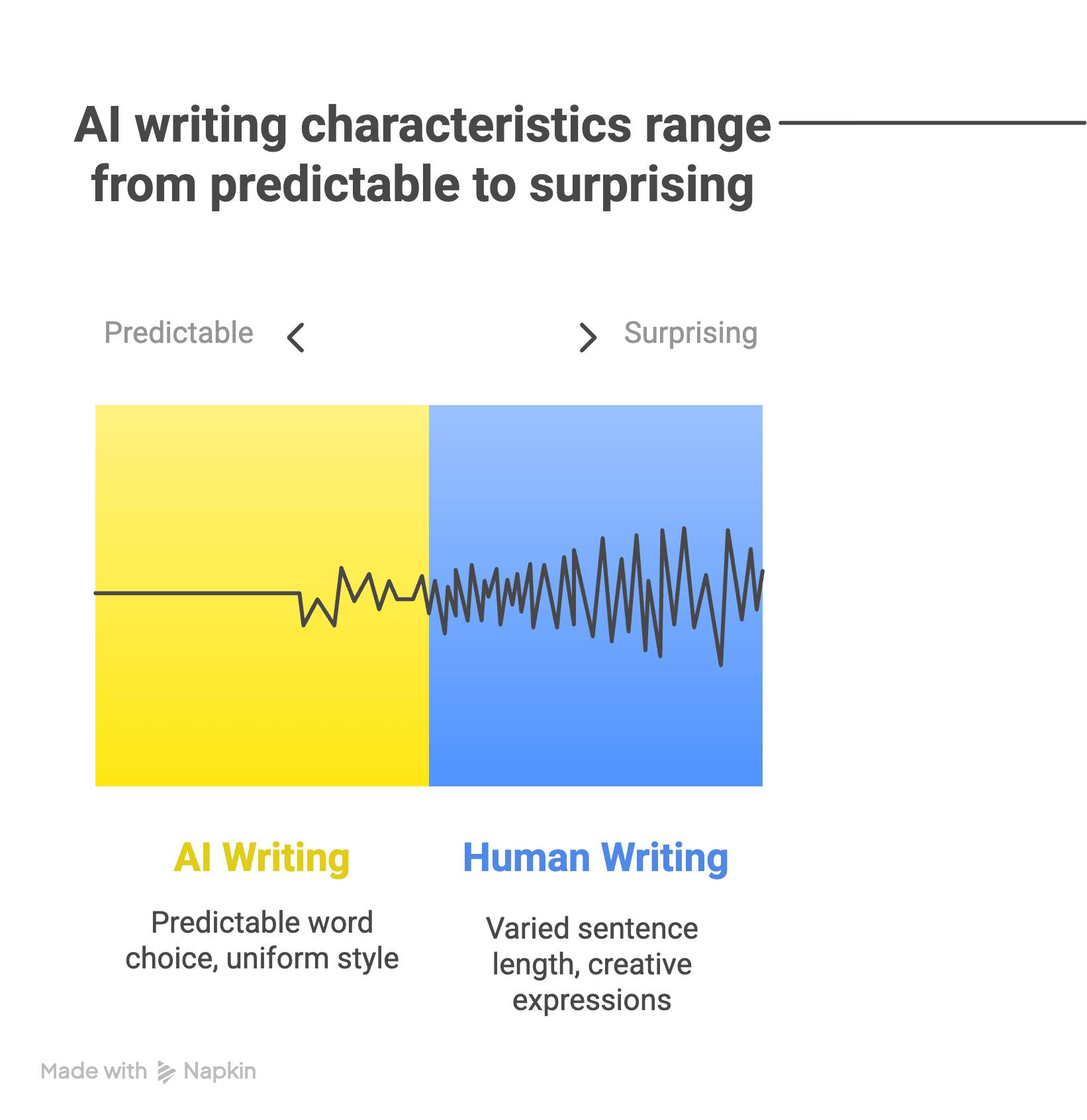
- Burstiness: This refers to the variation in sentence lengths and structures in the text – essentially, how “rhythmic” or uneven the writing is. Human writing usually has a mix of short, long, and medium sentences; it might be “bursty” with some complex sentences followed by a simple one.
AI-generated writing, on the other hand, tends to be more uniform and consistent, with most sentences being a similar length or structure. This is because AI models often stick to an average style that can sound a bit monotonous. If an article’s sentences all have a very similar length and pattern, showing little variety (low burstiness), an AI detector sees that as a clue that an AI might have written it. Conversely, high burstiness – a more uneven mix like you’d expect from an excited or creative human writer – leans toward human-authored text.
- Putting it together: An AI detector typically uses a language model (a kind of AI brain) to examine your text and calculate these metrics. In essence, the detector’s AI asks itself, “If I were an AI writing this, would I choose these words and sentence patterns?”. If the answer is yes the text is very predictable and even-paced – the detector concludes the text is likely AI-generated. If the text looks more chaotic or creative in a human way, it leans toward human-written. This analysis happens behind the scenes in seconds, resulting in a score or verdict about the text’s origin.
Below is a revised version of the “How Accurate Are AI Text Detectors?” section with a concise note about Merlin AI’s advanced techniques and high reported accuracy:
How Accurate Are AI Text Detectors?
AI text detectors are not 100 % foolproof. In fact, their accuracy varies and is often limited. Research and tests have found that no current tool can guarantee perfect results. Many detectors will give you a probability or score (e.g., “85 % likely to be AI-generated”) rather than a definite yes/no, because there’s always some uncertainty.
That said, a handful of tools consistently score higher than most. Independent and vendor benchmarks now put GPTZero and **Merlin AI’s ** AI Detector near the top: both use advanced, multi-signal analysis (combining perplexity, burstiness, semantic fingerprinting, and other statistical cues) and regularly report accuracy rates above 90 % on long-form samples. Merlin AI’s system in particular leverages proprietary ensemble models and large, continually updated training sets, giving it an edge in many real-world tests.
For context, earlier public evaluations found that the best-performing detector among paid services was about 84 % accurate, and the top free detector only around 68 %. Even OpenAI’s own experimental classifier correctly identified only 26 % of AI-written texts before it was discontinued for low reliability. These figures show that even the best detectors can miss AI-generated text or mistakenly flag human writing.
It’s important to note that longer texts give detectors more to work with. Accuracy improves when the input is longer, since the detector can gather more signals across multiple sentences. With very short snippets (a single sentence or just a few words), detectors struggle – there’s simply not enough pattern to separate AI and human writing. Many experts therefore recommend at least 100 words for more reliable analysis. If you paste only a tiny paragraph into any detector, take the result with a large grain of salt.
Limitations of AI Text Detectors
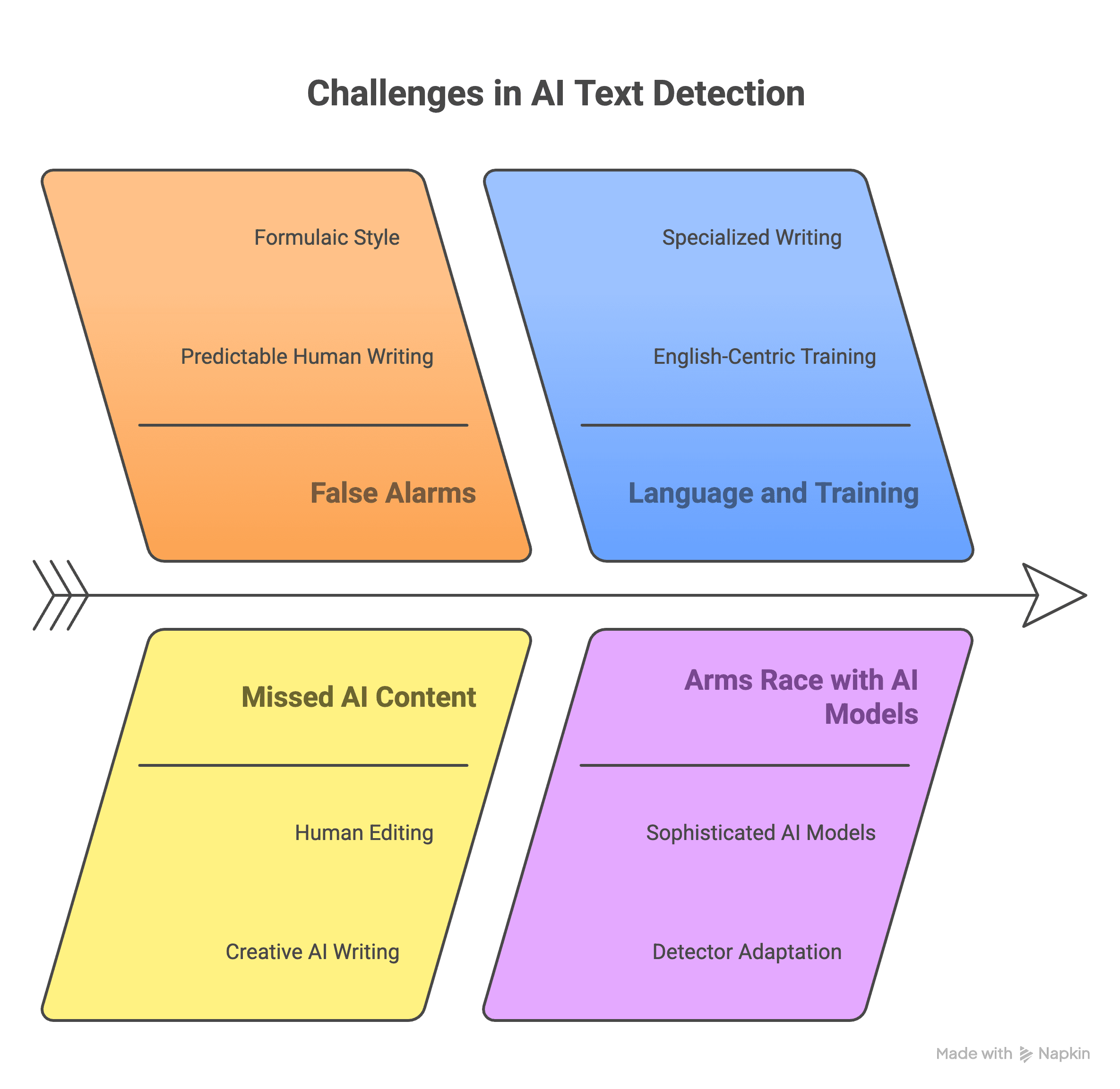
Beyond just accuracy percentages, there are some inherent limitations and challenges with AI text detectors:
-
False Alarms (False Positives): An AI detector might sometimes wrongly label a completely human-written piece as “AI-generated.” This can happen if a human writer happens to write in a very straightforward or formulaic style that the detector finds too predictable. For example, a student writing a very clean, error-free essay using common phrases could be unlucky enough to trigger the detector’s criteria for “AI-like” text. Such false accusations are a big concern, especially in education or professional settings.
-
Missed AI Content (False Negatives): Detectors can also miss AI-written text if that text doesn’t fit the usual AI pattern. If a piece of AI content has been heavily edited or paraphrased by a human, it might no longer have the low perplexity or uniform style the detector is looking for. Similarly, if the AI was instructed to write in a more chaotic or highly creative style (introducing more randomness), the output might fool the detector by mimicking human “burstiness”. In other words, the more an AI-written text is made to look less like typical AI output, the harder it is for current detectors to catch it.
-
Reliance on Language and Training: Most AI detectors are trained on examples of English AI and human text. They may not be as reliable for other languages or for very specialized writing. Their judgment is only as good as the patterns they’ve learned. If a detector hasn’t seen much of a certain writing style or language, it might make more mistakes.
-
Arms Race with AI Models: The landscape is constantly changing. As AI writing models get more sophisticated at producing human-like text, detectors have to keep up. It’s a bit of a cat-and-mouse game – new AI models try to sound more human, and then detectors adjust to new patterns. There’s a consensus that detectors will always be racing to catch up with the latest AI writing techniques. Even detector developers admit that no tool can be a definitive proof, and many schools or organizations do not treat detector results as conclusive evidence because of these uncertainties.
-
Not Meant as Proof: Think of AI detection results as suggestive, not proof. Developers recommend using them as one indicator, not as a sole judgment. The tools are best for flagging suspicious text for a closer human review, rather than outright declaring someone guilty of using AI. Misuse or over-reliance on detectors (like punishing a student solely based on a detector’s word) can be problematic given the error rates.
The Future: Can AI Detection Improve?
AI text detectors are still evolving. Researchers and companies are exploring new ways to make detection more reliable. One promising idea is to use hidden watermarks in AI-generated text. For example, OpenAI has floated the concept of having their AI writing tools insert an “invisible” pattern or code into the text they produce – not a visible code, but a statistical pattern that doesn’t affect the readable content.
This would be like a secret signature that another system could later recognize with certainty. If such watermarks can be implemented, it could allow near-100% reliable detection of AI-origin text. However, as of now this is only experimental – no major AI system has widely deployed detectable watermarks yet, and it’s unclear how editing the text after generation might distort such a watermark. So, for the time being, detectors must rely on analyzing the text itself, with the imperfections we discussed.
Final Thoughts
An AI text detector is a handy tool to guess if something was written by a person or an AI, and it works by checking how the writing feels in terms of predictability and variation. For general readers, the key takeaway is that these detectors look for signs of “too-perfect” writing. They serve an important role as AI-generated content becomes more common, helping maintain transparency and honesty in academia, publishing, and online content.
However, it’s equally important to understand their limitations. AI detectors are getting better, but they’re not magical all-knowing oracles – they can make mistakes in both directions. Use them for insight, but always apply human judgment and context. As AI technology advances, we can expect both AI writing and AI detection to improve in tandem, each responding to the other. For now, knowing how they work helps us use them wisely and interpret their results with a balanced perspective.
Experience the full potential of ChatGPT with Merlin


Hanika Saluja
Hey Reader, Have you met Hanika? 😎 She's the new cool kid on the block, making AI fun and easy to understand. Starting with catchy posts on social media, Hanika now also explores deep topics about tech and AI. When she's not busy writing, you can find her enjoying coffee ☕ in cozy cafes or hanging out with playful cats 🐱 in green parks. Want to see her fun take on tech? Follow her on LinkedIn!


