AI Detectors vs. Traditional Plagiarism Checkers: 5 Critical Differences
Learn five core differences between AI detectors and plagiarism checkers so you can pick the right tool to safeguard originality.
Why Content Screening Matters in 2025
The internet never sleeps. Essays, blog posts, résumés, and marketing copy land online every second—and more of that text than ever is auto-generated by AI. At the same time, classic copy-and-paste plagiarism still exists. If you publish, teach, or simply care about originality, you need tools that spot borrowed or bot-written words before your audience does. Two families of software help: AI text detectors and traditional plagiarism checkers. They share a goal—protect content integrity—but the way they work, what they catch, and where they can trip up are very different. Understanding those differences saves you headaches, false alarms, and wasted subscriptions. (Need a refresher on what an AI detector actually does? Check out our companion guide AI Text Detectors Explained: How They Work & Accuracy.)
What Is an AI Detector?
An AI detector estimates whether a passage was produced by an artificial-intelligence language model rather than a human mind. It doesn’t search the web for matches. Instead, it studies the text’s statistical fingerprint:
-
Perplexity (how predictable each next word is).
-
Burstiness (how much sentence length and rhythm vary).
-
Deeper patterns such as repetition, filler phrases, and probability spikes.
If the detector sees ultra-smooth predictability and steady sentence cadence—hallmarks of many AI models—it raises a flag. Modern detectors layer several signals and may run the text through their own mini language models to score “AI-likeness.” In the end, you get a probability (for example, “92 % likely AI-generated”). It’s an informed guess, not a legal verdict, but it’s usually good enough to prompt a closer human look.
What Is a Traditional Plagiarism Checker?
A plagiarism checker asks a simpler question: Has this wording appeared somewhere else before? The tool splits your text into phrases, then compares them against vast databases—journal articles, student papers, books, websites, and academic repositories. When it finds strings of words that match existing sources above a set threshold, it highlights them and provides links. Plagiarism software does not care who wrote the text; it only cares whether the words are copied. If you paste paragraphs from Wikipedia, the checker will scream. If you generate pristine, brand-new text with ChatGPT, the checker will shrug, because no direct match exists. That narrow focus makes plagiarism tools excellent at catching verbatim theft but blind to AI originality.
Difference 1: Source vs. Similarity
-
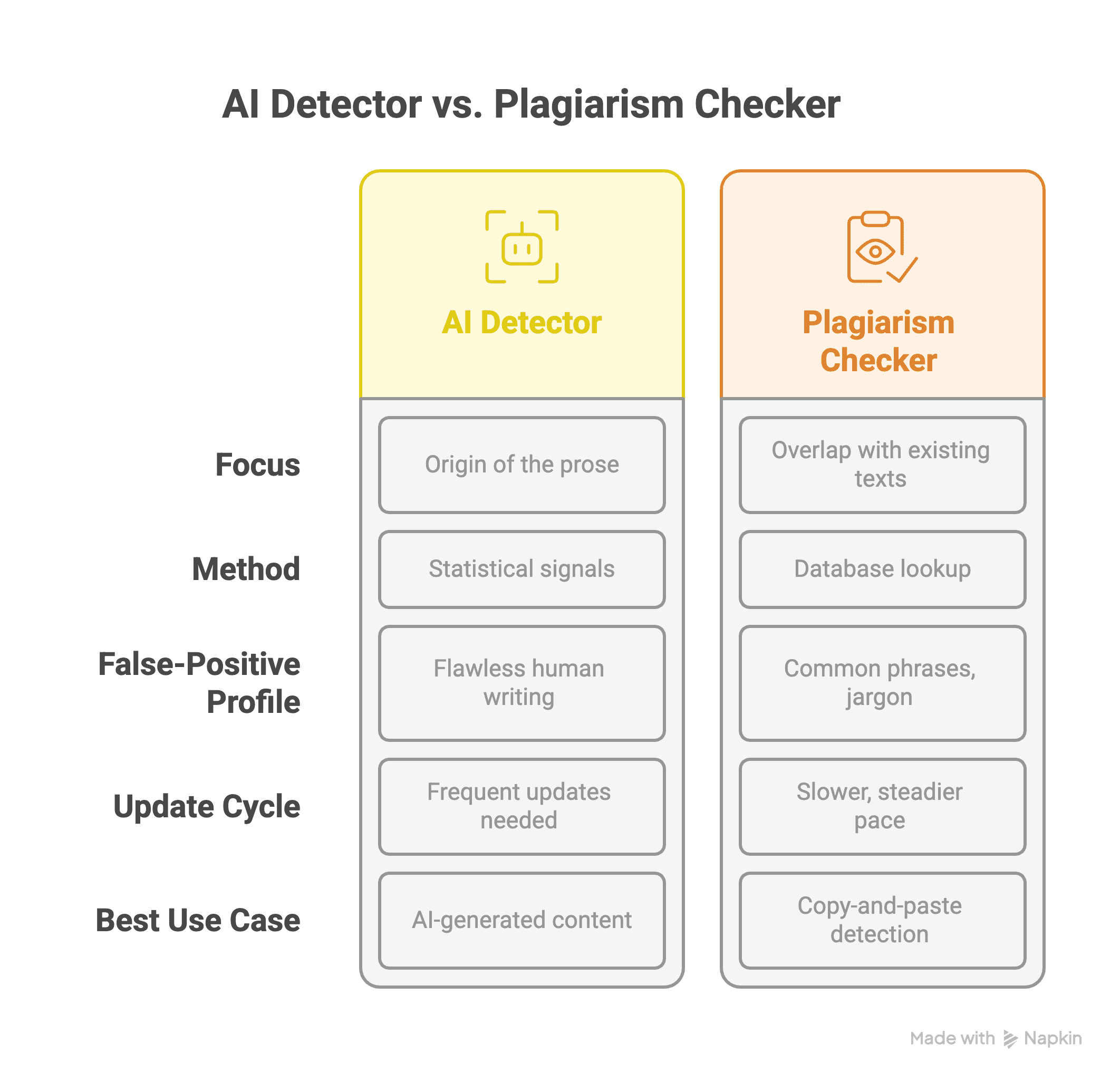
AI Detector: Focuses on the origin of the prose. It asks, “Does this read like it came from an algorithm?”
-
Plagiarism Checker: Focuses on overlap with existing texts. It asks, “Has this wording been used before?”
-
Why it matters: Suppose two students turn in papers. Student A copies three paragraphs from an online article verbatim. Student B writes an original paper entirely with an AI assistant. The plagiarism checker easily nails Student A.
The AI detector likely flags Student B.
Each tool catches what the other might miss. Relying on just one creates blind spots.
Difference 2: Statistical Signals vs. Database Lookup
- AI detectors run probability calculations. They analyze how often certain word patterns appear in human writing versus AI output. No external source is needed. Even if the text has never been published anywhere, the detector can still evaluate its “bot-ness.”
- Plagiarism checkers perform giant database lookups. Their strength depends on how many books, papers, and websites they have in their index. A sentence absent from the index appears “clean,” even if it was copied from a source outside the database or from an obscure paywalled journal.
- Takeaway: AI detection is pattern-based; plagiarism checking is match-based. One predicts, the other compares. Mixing the two gives a more complete safety net.
Difference 3: False-Positive Profiles
Every screening method misfires. Understanding when helps you interpret reports calmly.
-
AI Detectors: They can mistakenly flag flawless human writing—think press releases, legal contracts, or an English student’s super-polished essay. These texts have low perplexity and uniform rhythm, just like an AI model.
-
Plagiarism Checkers: They often over-highlight common phrases (“in conclusion,” “the purpose of this study”) or technical jargon shared across many papers. A high similarity score can look scary until you realize most matches are generic language.
Being aware of each tool’s false-positive style prevents unfair accusations and endless rewrites. Always review highlighted sections manually before making a judgment.
Difference 4: Update Cycle & Arms Race
AI writing models evolve monthly. When a new version becomes more human-like, yesterday’s detector can struggle. Developers must retrain detectors constantly—an arms race. Plagiarism databases grow too, but at a slower, steadier pace. Content from five years ago is still in the index; brand-new AI text won’t be unless someone publishes it online. As a result, plagiarism tools age gracefully: their core logic (string matching) hasn’t changed much in two decades. Implication: AI detectors demand frequent updates to stay accurate; choose vendors with active research teams. Plagiarism checkers depend on licensing the largest, freshest database; pick providers known for broad coverage.
Difference 5: Best-Fit Use Cases
| Scenario | Best Tool | Why |
|---|---|---|
| Checking if a student wrote an essay with ChatGPT | AI Detector | Flags AI-style text even when no copy-paste exists. |
| Spotting copy-and-paste from Wikipedia | Plagiarism Checker | Matches exact wording against public web pages. |
| Verifying originality of news articles before publishing | Both | AI detector finds ghost-written sections; plagiarism checker finds unattributed quotes. |
| Corporate compliance for policy documents | Plagiarism Checker | Protects against accidental reuse of proprietary language. |
| Screening AI-generated marketing drafts | AI Detector | Ensures content isn’t entirely machine-produced. |
The table shows that neither tool is a one-size-fits-all solution. Match the tool to the problem for best results.
Wrap-Up: Choosing the Right Checker
AI detectors and traditional plagiarism checkers serve the same big goal—trustworthy text—but they attack different threats. AI detectors sniff out machine-generated prose; plagiarism checkers hunt copied passages. Each has its blind spots. If originality truly matters, layer them: run a plagiarism scan first for blatant copying, then run an AI detector to gauge authorship. Combine the reports with human judgment, and you’ll protect your content from both the bots of the future and the copy-cats of the past. And don’t forget to dive deeper into detection basics in our linked explainer above.
Experience the full potential of ChatGPT with Merlin


Hanika Saluja
Hey Reader, Have you met Hanika? 😎 She's the new cool kid on the block, making AI fun and easy to understand. Starting with catchy posts on social media, Hanika now also explores deep topics about tech and AI. When she's not busy writing, you can find her enjoying coffee ☕ in cozy cafes or hanging out with playful cats 🐱 in green parks. Want to see her fun take on tech? Follow her on LinkedIn!


